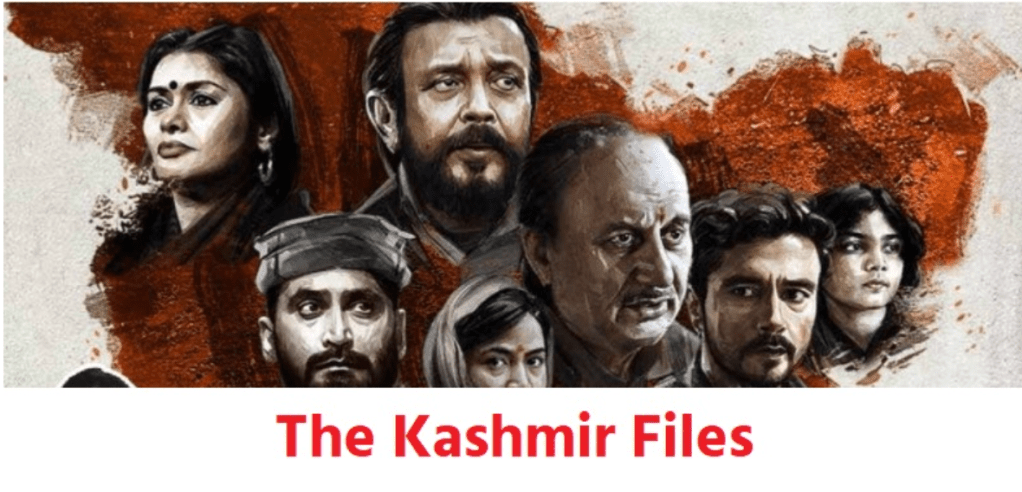
Movies impact our lives in one way or another. They make us smile, cry, feel pain, and various other emotions. The Bollywood film industry has had a long passage of making movies known for their golden era showmanship to where it is now. But of late, I’ve noted that most Bollywood movies fall short of good entertainment as many are repetitive, lusterless, and often unoriginal. But some go beyond the barrier of mere entertainment and provide deep insights and value. After almost two years of a pandemic lockdown, I entered a theatre last week to watch the movie The Kashmir Files. I did not know that this movie triggered a national commotion about its content, focus, intent, and credibility.
I’ve heard various sentiments from those who oppose or favor this movie, and their opinions are largely echoed by the media commentators and their fervent reviews about the movie. Many critics view this movie as a flawed interpretation of actual events or selective presentation, while others label it indoctrination or propaganda. But I would be remiss not to notice the narrative quality and presentation and the impeccable performance by many well-known artists helped build a stimulating plot. What stood out for me was that this movie exposed human vulnerability. Added to that is the larger vulnerability of a nation entangled in a post-independent era of inequitable growth, identity, and political concentration of power where people of minority groups are most adversely affected by the policies, actions, and apathies of the government.
Kashmir was known as the hub of research and knowledge for scholars worldwide, an important detail underlined in the climax scene of the movie. But the harsh reality of the Kashmiri Pandits was brilliantly delivered in a single dialogue in the film, “Kaisee vidambana hai…Kashmeer ko log jannat maanate hain. aur Kashmeer ko jahannum banaane vaale bhee jihaad isalie karate hain ki unhen jannat mile.” To paraphrase and translate, it is such irony that people consider Kashmir a paradise, but the people who make hell for others in Kashmir do it in the name of jihad so they can go to heaven.
The director used powerful and moving personal stories to showcase parallel worlds and ideologies about a place most know little about. A thought-provoking take!

While the Western world seeks to understand better and adopt an inclusive framework of diversity and equity in all spheres of their lives, I find this discourse essentially nonexistent in India’s academic, social, and political circles. It’s almost as though equity, diversity, and inclusion are constructs independent of other variables when in fact, racial and ethnic minority cleansing is at the forefront of most social evils in this nation.
Race and ethnicity are often used as clichés for education and employment, especially for quotas and reservations that avoid any sense of the reality of a mounting divide in India’s socially, economically, politically inequitable society. For example, most people increasingly rely on low-wage workers, child laborers, and house servants to do the bulk of work that the rest of us cannot or aren’t willing to do. At the same time, we callously indulge in flippant discussions about race, ethnicity, equity, and inclusion with no real meaning or impact.
Perhaps one of the reasons why so many people are rushing to watch The Kashmir Files is because the story shines a spotlight on some of the most pressing issues facing our society – race and ethnic consciousness. The movie brings to the forefront how ethnic violence and ethnic cleansing of innocent people are repeatedly used in the name of religion, or in other words, terrorism.

Watching this movie brought back memories of the 1980s in Punjab that started a decade-long insurgency by Sikh militants in northern India that changed everything for me as a kid growing up in a village in Punjab. The frequent hidings, an eerie silence of anticipated ambushes and the constant fear of death, and the sound of bullets firing still haunt my memories of those times. Terrorism can be a slow-moving target of intimidation, radicalism, violence, and extremism. Still, history shows that when a nation and its people don’t stand up against hate, it can breed absolute madness carried out principally against innocent women, children, and older adults, all under the guise of religion.
The religious persecutions, exodus, and genocide carried out against the Kashmiri Pandits, as illustrated in The Kashmir Files, is a soul-stirring reminder of how the actions and inactions of the government, educational institutions, and politicians can infringe upon the rights and values of the minority groups in a secular, sovereign, and democratic country like India.
Regardless of your stand regarding this movie, it provides the movie-goers with a critical perspective. They must decipher and define themselves and not be force-fed like a typical Bollywood movie. The movie critics are proof of that. The bottom line is people affected by terrorism in Kashmir and elsewhere have suffered a lot. The scars of terrorism forever remain for those who have faced uncertain death and devastation. Movies like this can usher a new era of entertainment in the Bollywood industry and the type of audience it attracts. Once the dust settles on what people think this movie is and isn’t, it is culturally and historically significant and has the hallmarks of a critically acclaimed international audience.

 Ruby's Musings