What the Walls Remember

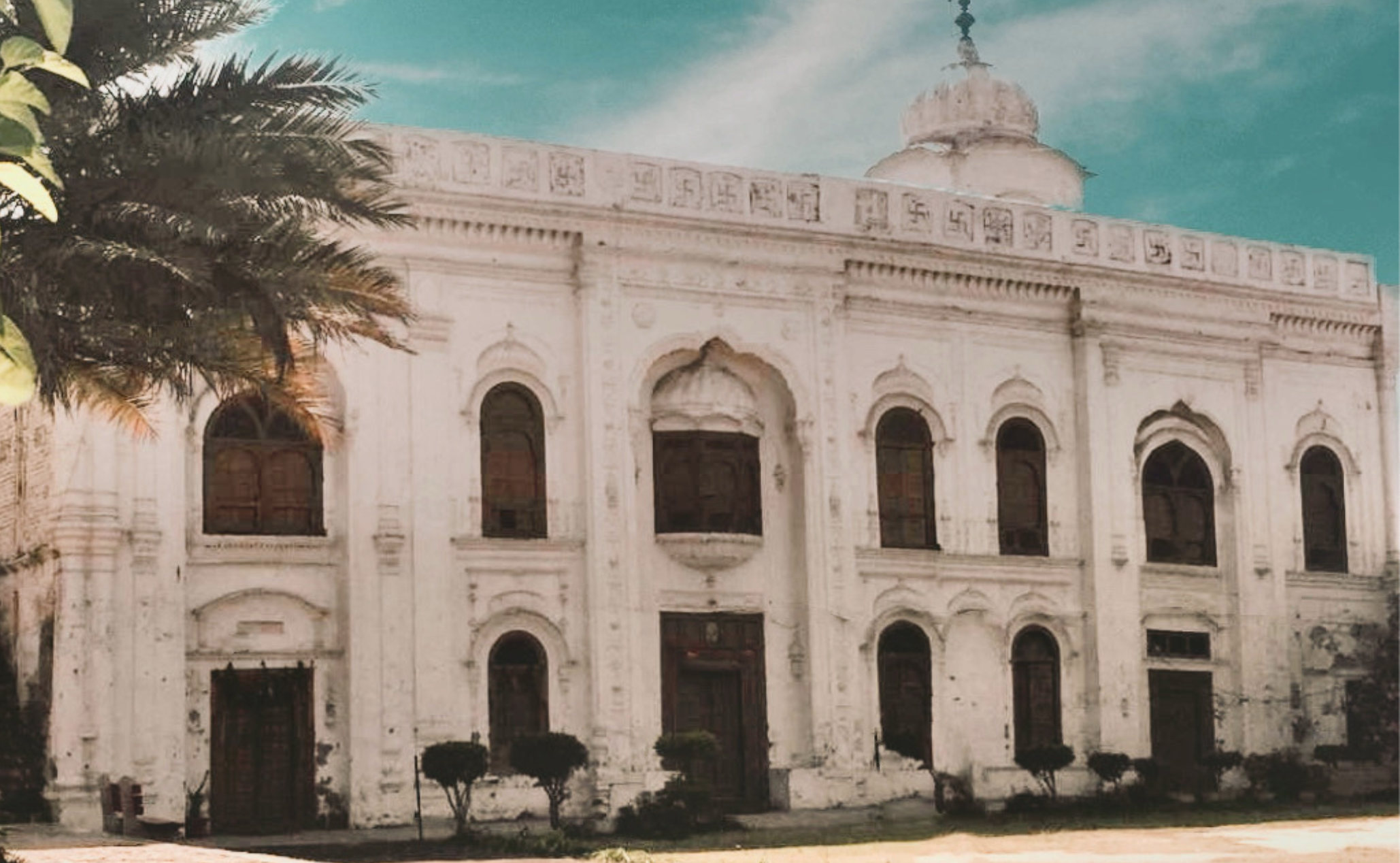
I am standing inside Pothi Mala, and the walls are still speaking.
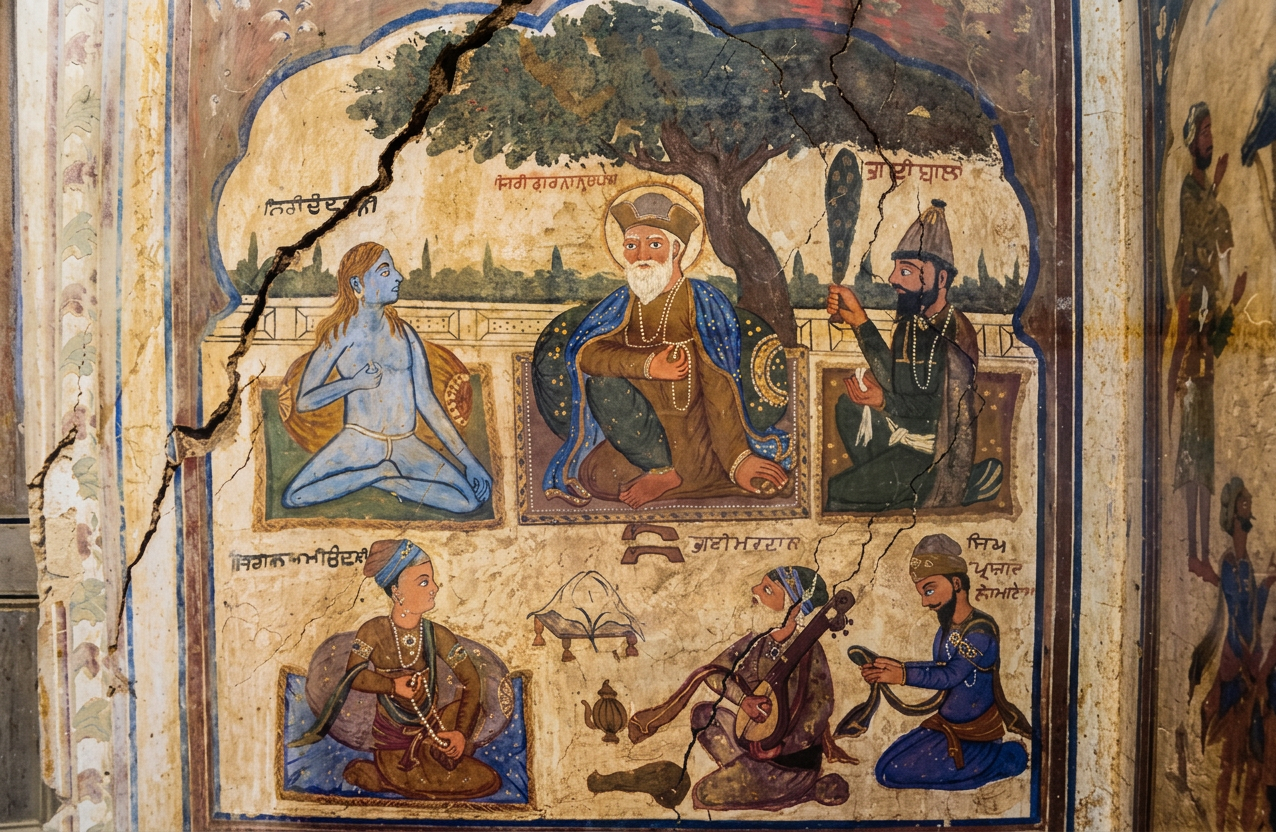
It takes a moment for my eyes to adjust — to move from the blinding Punjab afternoon into the cool, dim interior of a building that has stood since 1745. Then, slowly, they appear: hundreds of frescoes covering every surface from floor to ceiling, their colors faded but not gone, their stories intact.

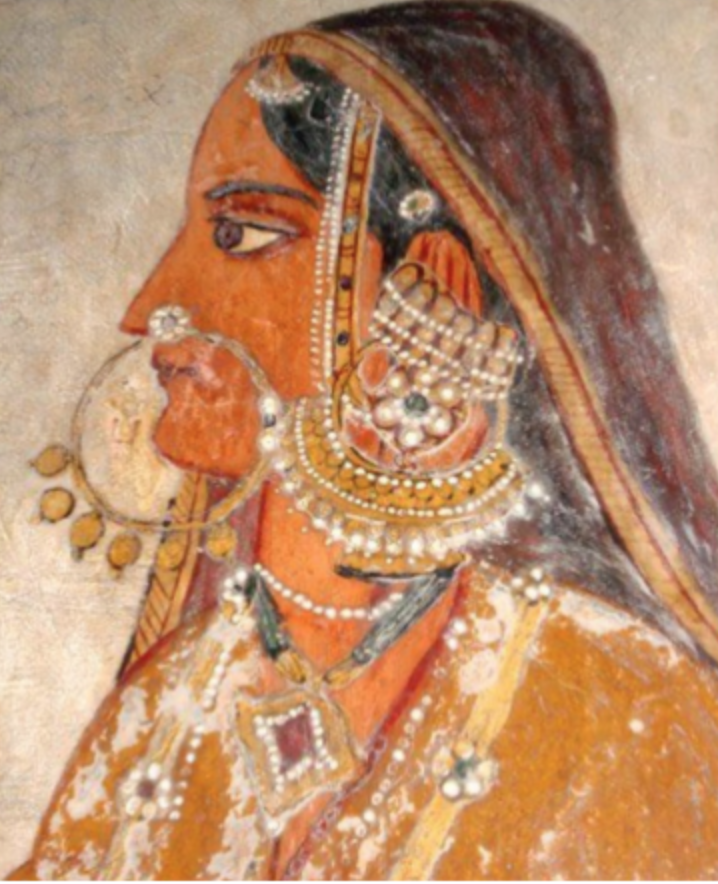
A mural of Guru Nanak Dev in a quiet assembly. Scenes from the Ramayana rendered in ochre and indigo. Krishna tending cows in the forests of Vrindavan. The great Punjabi lovers — Heer and Ranjha, Sohni and Mahiwal, Sassi and Punnu — are depicted in flowing lines that have survived nearly three centuries of heat, monsoon, and neglect.

One mural stops me every time: the wedding of Lord Krishna and Rukmini, rendered in extraordinary detail. Women adorned in their finest clothes and jewelry crowd the balconies of a three-story structure. Among the wedding guests stand the Holy Trinity — Brahma, Vishnu, and Mahesh — each painted with quiet reverence, their presence a blessing upon the sacred union. Nearby, a life-sized figure of Lord Brahma surveys the room. These are not merely illustrations. Scholars who study Indian wall painting believe it is among the oldest surviving visual narratives of its kind — representations of the Satyug, the Golden Age, when divinity and humanity were understood to coexist in harmony.

Another section of walls is given entirely to Lord Krishna: his playful youth, serenading the forest with his flute while tending to cows; perched mischievously in a tree while the Gopis bathe in the river below; sitting attentively as he receives teachings from a revered sage. Scenes from the Ramayana unfold as a sequential narrative — Ram, Sita, and Lakshman exiled to the forest; the golden deer that lures them away; Ravan, disguised as a holy beggar, approaching Sita in their absence. The painters understood that a story told in images speaks to anyone who can see, whether or not they can read.

And then there are the Punjabi folk romances — Heer and Ranjha, Sohni and Mahiwal, Sassi and Punnu. These are the love stories of Punjab, its answer to Romeo and Juliet, grounded not in the courts of Verona but in the rivers, deserts, and mustard fields of this specific land. Their presence on these walls alongside scenes from Hindu epics and Sikh sacred history is itself a statement: that this building was never a shrine to one tradition alone.

Above me, the ceiling is a masterwork of painted wood panels and inlaid glass, intricate as a jewel box — every surface a continuation of the devotion that covers the walls below. Around me, the murals tell the story of a civilization that believed art was devotion, that beauty was a form of prayer.

These frescoes were painted in the ancient buon fresco tradition—pigments mixed with water and applied directly to wet lime plaster, fusing into the walls as they dried. Unlike paintings on canvas or panel that can be moved, restored, or stored, frescoes are inseparable from their architecture. You cannot save the art without saving the building. They are not decorations. They are the architecture.

And the architecture is crumbling.

Sections of the roof have collapsed. Deep fissures run along the walls, cutting through the painted faces of gods and lovers alike. In places where the ceiling has given way, rain has done what centuries of time could not — erased what was there. Each collapse takes with it something irreplaceable: a fragment of India’s sacred visual history, a brushstroke from an artisan who worked in devotion and whose name we will never know.

I grew up inside these walls.

My family has guarded this place for generations — we are Sodhis, direct descendants of Guru Ram Das, the fourth Sikh Guru and the founder of Amritsar, the spiritual capital of Sikhism — and Pothi Mala was entrusted to us as a sacred responsibility long before I was born. As a child, I understood the building the way children understand great things: as simply given, permanent, woven into the fabric of the world.

It was only later — much later, standing in California with my father’s death fresh in my chest — that I began to understand what it means for a place like this to disappear. And how easily it can happen. And how many forces are aligned to let it?

My ancestor Jivan Mal built Pothi Mala in 1745, a direct descendant of the Sodhi lineage. He named the village that grew around it Guruharsahai, in honor of the Gurus and the spiritual heritage they represented.

The building was constructed to house the Pothi Sahib, a revered collection of sacred Sikh texts handwritten by Guru Nanak Dev Ji, along with relics entrusted to the Sodhi family as guardians of the faith. For generations, it served as a living center of devotion, community, and memory—a place where disputes were brought for resolution, where families gathered, where the sacred and the everyday met. It was believed that speaking the truth in the presence of Pothi Mala brought clarity and resolution, and that those who chose deception would eventually face the consequences of their karma. Such was the power of belief that people placed in this space.

The Pothi and the Mala were eventually lost. But some relics remained: Padam Sahib, Saligram Sahib, and the Topi — belongings of Guru Nanak Dev Ji. And the building itself remained.

What makes Pothi Mala singular — what makes it, in my view, a site of genuine global significance — is not only the age of its frescoes or the quality of its craftsmanship, though both are extraordinary. It is what those frescoes collectively represent. The murals span three distinct traditions: Hindu, Sikh, and Punjabi folk. Artisans from different religious backgrounds painted them side by side, working together in an act of collaborative devotion that was never remarkable to them because it was simply how things were done. No single tradition dominates. No hierarchy organizes the walls. The Sikh Gurus share space with the Hindu Trinity. The sacred love stories of Punjab share space with the cosmic battles of the Mahabharata. It is, in the most literal sense, a monument to coexistence — built at a time when coexistence was not a political aspiration but a daily practice.

At a time when India is grappling with rising religious and communal tensions, this is not a small thing. Pothi Mala is a physical argument against division. Its existence says: this is what we were capable of. Its slow destruction says: we have forgotten.

The building predates the United States. Its frescoes predate most of the institutions now charged with protecting India’s heritage. Yet no government body has given it protected status. No conservation effort has been mounted. The Archaeological Survey of India, which oversees thousands of monuments across the country, has not intervened. The Punjab state government has not acted. Heritage protection bodies have not acted. The building continues to collapse.

My father understood what Pothi Mala was. He spent decades trying to make others understand it, too.

He was not a nostalgist. He was a practical man who had worked in public life and understood how institutions functioned — and how they failed. He submitted applications. He wrote letters. He met with officials. He sought heritage status, restoration funding, and public recognition for a building that he knew, with the certainty of someone who had grown up inside it, was irreplaceable. As he aged, his sense of urgency intensified. He could see the cracks in the walls deepening. He could see the roofline beginning to give. He understood that each monsoon season was another round of damage that no future conservation effort could fully undo.

It was not enough. The applications were ignored. The letters went unanswered. The officials smiled and offered nothing. And when my father died, the building lost its most persistent advocate — the person who had spent the longest fighting for it, who carried its history in his body, who would walk its courtyards in the early morning and simply stand there, as if by standing he could hold the walls up.

I inherited his grief and his unfinished work in equal measure. And I inherited, too, a question I have not been able to set down: what does it mean that a civilization can build something this extraordinary — this beautiful, this inclusive, this enduring — and then simply allow it to disappear?

To understand why Pothi Mala is being lost, you have to understand the political economy of rural Punjab.

Since independence, village governance in places like Guruharsahai has been shaped less by policy than by personality — by patronage networks and the slow entrenchment of corruption at every level. Agrarian reforms of the mid-twentieth century gave way to identity politics. Religious institutions that might have protected cultural heritage became instruments for consolidating political power.

The militancy of the 1980s brought development in rural Punjab to a near-complete standstill. Entire communities were traumatized. Infrastructure projects were abandoned. The institutions meant to serve villages like Guruharsahai became either dysfunctional or complicit. While cities began to recover through the 1990s, rural Punjab was left behind — its cultural landmarks unprotected, its young people without economic prospects, its memory slowly bleeding away. The liberalization era that followed concentrated wealth in the hands of the politically connected, deepening the divide between those who could leave and those who could not.

Every election cycle follows the same script — the next arriving in February 2027. Politicians appear with promises. Cash and alcohol circulate quietly in exchange for votes. The election ends. The politicians disappear. In the years I have been watching, not one has taken meaningful action to restore or protect Pothi Mala. Applications submitted to government bodies seeking heritage status or restoration funding have been ignored or denied. Local school curricula make no mention of the historic building that stands at the center of the village. An entire generation of young people in Guruharsahai is growing up without knowing what their village holds.

Meanwhile, the drug crisis that has ravaged rural Punjab for decades has reached Guruharsahai with particular force. A generation of young men is being lost to addiction, sustained by networks of politicians, traffickers, and middlemen who operate with impunity. The community’s protectors are too often in league with its destroyers. Hope has become a rare commodity. And into this vacuum of despair, Pothi Mala stands — not as an answer, but as a reminder of what was once possible here.

There is also the quieter damage — the kind done not by neglect but by deliberate distortion. In the age of digital media, the history of a place like Pothi Mala is vulnerable to manipulation. False genealogies circulate online. Public platforms are edited to replace documented history with fabricated narratives. Pseudo-histories appear, written by those who seek to claim an inheritance they were never given. The erasure of memory, it turns out, does not always come from indifference. Sometimes it is engineered.

A larger question lies beneath all of this — one that extends well beyond a single building in a single village in Punjab.

Who is responsible for the preservation of sacred cultural heritage when the institutions meant to protect it fail? This question is not unique to India. Across the world, heritage sites are disappearing—through neglect, conflict, the deliberate erasure of histories that powerful groups find inconvenient, and the simple indifference of governments with other priorities. The international community has developed frameworks to respond: UNESCO’s World Heritage program, the Hague Convention for the Protection of Cultural Property in the Event of Armed Conflict, and the work of organizations such as the World Monuments Fund and the Aga Khan Trust for Culture. These frameworks exist because the world has recognized, at least in principle, that certain things belong to everyone — that the loss of Palmyra, the Bamiyan Buddhas, or the manuscripts of Timbuktu is not merely a local tragedy but a wound to the shared human record.

Pothi Mala has not been nominated for any international protection. It does not appear on UNESCO’s tentative list. The Archaeological Survey of India does not recognize it as a protected monument. For official heritage frameworks, it exists as if it does not exist at all—a building of extraordinary historical, artistic, and spiritual significance that has somehow fallen through every net meant to catch things worth saving.

Part of the reason is institutional: the systems for identifying and protecting heritage sites in India are overstretched, underfunded, and vulnerable to the same political pressures that have failed Guruharsahai at every level. Part of the reason is geographic: rural Punjab is not on the itinerary of scholars and heritage professionals who might otherwise recognize Pothi Mala. And part of the reason is epistemological — a question of whose knowledge counts, whose testimony is taken seriously, who gets to declare something significant. The descendants of those who built and maintained Pothi Mala have been saying for decades that it matters. That testimony has not been enough.

What would it take for the world to see Pothi Mala? Not through the eyes of a descendant — through the eyes of an institution with the power to act? I think of the conservation programs at universities like the Courtauld Institute in London, the Getty Conservation Institute in Los Angeles, and the National Museum Institute in New Delhi. I think of the international heritage organizations that have intervened to save buildings no less obscure than this one in other parts of the world. I think of the individual collectors, foundations, and cultural philanthropists who understand that the preservation of art is not sentiment — it is the maintenance of the human record.

I often think about the artisans who painted these walls.

We do not know their names. We do not know which tradition each came from, though the evidence of the murals themselves — the fluency with which Hindu iconography sits alongside Sikh sacred history and Punjabi folk romance — suggests they came from different faiths and worked together without apparent tension. They mixed their pigments with water and applied them to wet plaster, knowing that what they were doing would last. They painted gods, lovers, sages, and warriors. They painted the cosmic and the human side by side. They painted beauty as an act of devotion — not to any single tradition, but to something larger than tradition.

What they created is, in the most precise sense, a document. Not a political document or a theological document, though it is both of those things, too. It is a document of what human beings can do when they work across differences toward something shared. In an era of rising division — religious, communal, political — that document has never been more urgently needed. And it has never been closer to disappearing.

Preservation, in this sense, is not conservation. It is not merely the technical work of stabilizing plaster and restoring pigment, though that work is necessary and urgent. It is an act of moral attention — a declaration that this matters, that the people who built it mattered, that the civilization that produced it deserves to be remembered. To preserve Pothi Mala is to insist that coexistence has a history. That it was not always an aspiration — that once, not so long ago, it was simply how things were done.

My father spent the last decades of his life trying to make that argument to people who were not listening. I am making it now, in a different medium, to a different audience, hoping that somewhere in the distance between his generation and mine, something will shift.

I am standing inside Pothi Mala, and the walls are still speaking.

The question is whether anyone is still listening.

The Summer Slide: What It Is and How to Prevent It

–By Ruby Sodhi, Ph.D.

Summer break is a long-awaited season. Children eagerly anticipate the freedom of sunny days, family vacations, sleepovers, camps, and a break from school routines. Parents, meanwhile, often find themselves balancing excitement with a familiar question: How can I make this summer both enjoyable and meaningful for my child?
At the beginning of summer, two and a half months can seem endless. Yet before we know it, July has come and gone, school supplies begin appearing in stores, and the countdown to the first day of school starts all over again.

Four children playing and splashing water in a small kiddie pool in a backyard


What happens between the last day of one school year and the first day of the next is more important than many people realize. Summer provides children with valuable opportunities to rest, explore, and grow. However, without some continued engagement in reading, math, and problem-solving, students can experience what educators call the summer slide.

What Is the Summer Slide?

The summer slide refers to the loss of academic skills and knowledge that can occur during an extended break from school. Research shows that some students, particularly younger learners and those already struggling with reading or math, may return to school having forgotten skills they worked hard to develop during the year.


Teachers often notice these gaps within the first few weeks of school. Time that could be spent building new skills is instead spent reviewing and rebuilding previous learning. While most students eventually regain lost ground, preventing the slide is much easier than recovering from it.

The Good News: Prevention Is Simple

Avoiding the summer slide does not require workbooks, tutoring sessions, or hours of
academic practice each day. In fact, small, consistent learning opportunities can make a
significant difference.

One of the most powerful tools is reading.

Summer reading books selected by teachers are often engaging, age-appropriate, and
designed to be enjoyed in short bursts. Just 15–20 minutes of reading a day helps maintain vocabulary, comprehension, fluency, and critical thinking skills. Reading also strengthens imagination, curiosity, empathy, and creativity in ways few other activities can.

Easy Ways to Keep Learning Alive

Here are a few simple ways to support learning throughout the summer:

Read Every Day
Set aside 15–20 minutes for independent reading, family reading time, or listening to audiobooks together.

Practice Math Naturally
Involve children in everyday math:
● Estimate the cost of groceries or restaurant meals.
● Calculate discounts while shopping.
● Measure ingredients while cooking.
● Compare prices and make budgeting decisions.

Build Executive Functioning Skills
Executive functioning skills help children plan, organize, prioritize, and manage tasks.
Summer provides countless opportunities to practice them.

For example:
● Have your child pack their own travel bag using a checklist.
● Ask them to plan the items needed for a day trip.
● Encourage them to create a schedule for completing chores or activities.
● Give them responsibility for managing a small budget during an outing.

These real-life experiences help children develop independence, problem-solving skills,
and confidence.

Small Steps Lead to Big Results
The summer slide does not affect every student equally, but all children benefit from
continued opportunities to read, think, and solve problems. Summer should absolutely be a time for fun, exploration, and family memories. Learning does not have to compete with those experiences—it can be woven naturally into them.

As parents, don’t feel guilty about encouraging your child to read, practice math, or take on new responsibilities during the summer months. A few minutes each day can make a
meaningful difference.

By making room for reading, math, and executive functioning skills this summer, you can help your child return to school confident, prepared, and ready for a strong start to the new school year.

The Call of the Hills

Whizz. Zip. Hum.

The hummingbird began its morning ritual early, its tiny wings moving so fast it seemed suspended in the air — hovering from flower to flower, gathering nectar pooled deep within their petals. Nearby, a squirrel traced its restless path across the rooftop, its chatter so familiar it had long since crossed into affectionate annoyance. 

Still, the day unfolded in a quiet glow, rising with warmth and sunlight.

Sitting on my deck, I breathe in the earthy freshness of the mountain air, feeling my lungs open with each breath. 

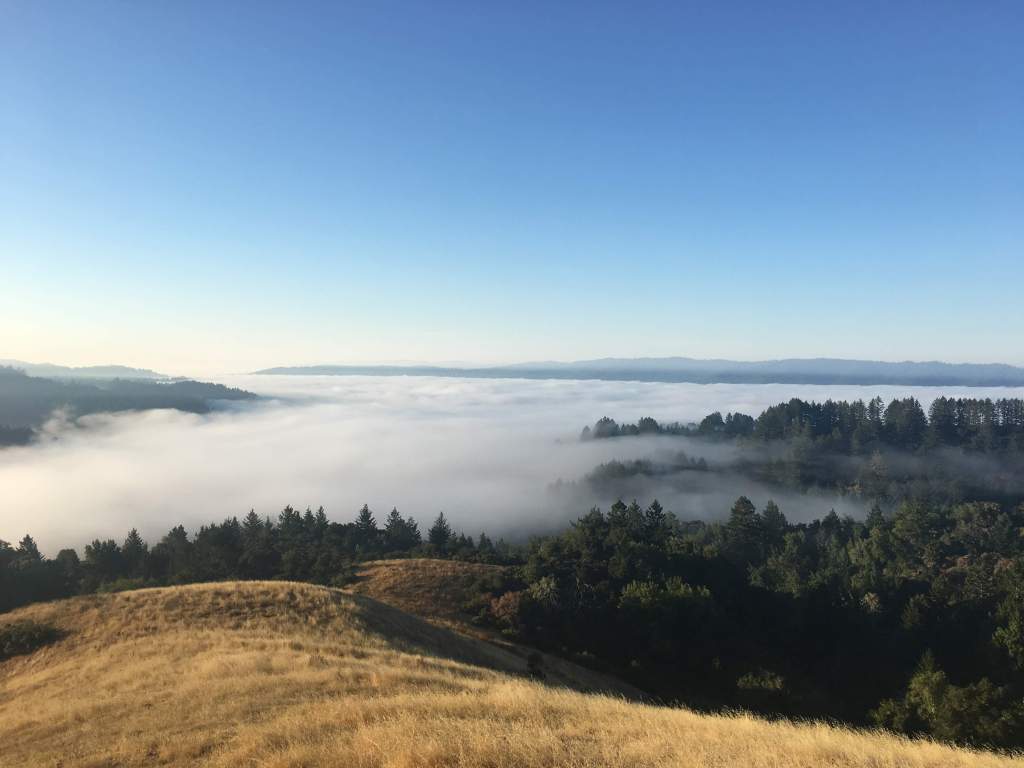
Sunrise and sunset, the slow unfurling of fog across the hills — all of it echoes a stillness that asks for nothing more than presence. The reddish-maroon hues of the redwoods reveal themselves not in full daylight, but as the sun dips toward the horizon, especially after rain, casting a warm glow across their ancient trunks.

Such is life in the Santa Cruz Mountains. For over fifteen years, I have lived within this almost ethereal landscape, and its everyday gifts have never lost their quiet magic.

The call of the hills has been nothing short of a dream come true for me. 

I was ten when I was sent to boarding school, nestled in the foothills of the Himalayas in India, at an altitude of about 7,500 feet, in the hilltop city of Shimla—once the summer capital of the British Raj. I was homesick for months. I spent my free time at the edges of the school’s seven playgrounds, overlooking an expansive valley layered with endless mountain ridges.

There were days when my eyes searched that landscape for something familiar, something that felt like home. Scattered across the terrain were rooftops in shades of red, green, white, and slate. From some, thin trails of smoke rose into the air, carrying the distant scent of wood fires and cooking. It felt warm and comforting.

I longed for a home like that—a quiet place nestled in the mountains, its rooftop barely visible among the trees. Three decades later, that is exactly where life brought me — and the mountains have been teaching me ever since.

Here in the Santa Cruz Mountains, each season brings its own character. On intensely hot days, the Redwoods release soft spatters of seeds into the air. On windy days, their mighty trunks sway as if in a slow waltz. Other days, fog rolls in to cradle the trees and the valley in a blanket of soft white cloud. 

To pass through on a winding road is to glimpse only the surface of this place. While visitors gather at its familiar parks and attractions, those who live here discover a quieter world—hidden trails and shifting landscapes that reveal themselves slowly, and only over time.

There is also a rich community of mountain dwellers who have chosen to make their lives within the folds of these peaks, valleys, and crevices. From the valley below, mountain dwellers are often misread — dismissed as hippies, isolationists, or simply eccentric. But those who live here have chosen something far more deliberate: a life balanced between connection and solitude, close enough to neighbors, yet deeply held within the embrace of nature.

That balance shapes daily life in quiet, thoughtful ways—from the size and structure of a home to its light, water, and relationship to the land. Living here is not accidental; it is an ongoing act of design, a careful tending of both space and self.

In the city, one has neighbors; in the mountains, we have community—people who genuinely care, who show up without being asked, and sometimes without even announcing themselves. That kind of quiet camaraderie feels increasingly rare in cities, where neighbors often know little about those living just next door.

And then there are the other neighbors. The quiet, constant presence of wildlife—the deer, bobcats, wild turkeys, skunks, foxes, coyotes, partridges, and, on occasion, a mountain lion. Here, adults and children alike don’t just read about these creatures; we live alongside them. There are moments—unexpected, almost surreal—when our human lives brush gently against theirs, and for a brief instant, we share the same space, aware of one another in a way that feels both humbling and extraordinary.

From the mountains of Shimla to Santa Cruz, their quiet call has traced an arc through my life. Perhaps that is their promise—that they do not draw us away from life, but deeper into it. Into stillness, into presence, into a way of being that cannot be hurried. The longing I carried as a child, looking out across distant mountains, was never just for a home, but for a feeling. And somehow, over time, that call was answered—softly, patiently—until I found myself living inside the very dream I once watched from afar.

What I Did Not Know How to See

When I lived in Humboldt County, the world felt almost too pristine. It was too open and too unhurried. I couldn’t fully surrender to its quiet rhythms. 

Life there moved at a pace that asked something different of me, something I didn’t yet know how to give. Living now in the Bay Area feels like an entirely different existence—denser, louder, propelled by urgency. 

Humboldt carried the spirit of an older world. It seemed to exist just outside the reach of time itself. The Bay Area, for all its energy and ambition, could never quite hold this spirit.

My life carried me from Northern California to what I think of as its middle stretch. Yet, I found myself missing what I had once struggled to inhabit.

I remember one afternoon in particular. I sat in my backyard and absorbed the warmth of a rare, sunlit day. It was a quiet gift after months of blistering cold and relentless rain. Reclined in a chair, I let the sunlight settle into my bones, the stillness wrapping itself around me like something earned.

Then, from a distance, I heard it: the low, steady hum of an engine. It grew gradually louder, pressing against the calm I had begun to feel. I looked up just in time. A low-flying airplane glided over the small town of Rio Dell. Its presence was brief but intrusive.

Moments later, it disappeared, and with it, the disturbance. A quiet relief followed.

But the sound returned. 

Again, it passed overhead. 

And then again. 

By the third time, I felt a flicker of irritation rise. It was almost enough to make me want to wave it away. I wanted to call out, Hey, I’m trying to rest here. 

But just as quickly, the thought softened. My four-year-old son was absorbed in his own small world. He chased a ball across the yard. His laughter was unbothered by the interruptions above. His presence pulled me back, gently, into the moment I had nearly lost.

I might have forgotten that afternoon entirely if, months later, something hadn’t brought it rushing back with unexpected clarity. While browsing in the library, I picked up a picture book and began turning its pages absentmindedly.

Then I stopped. 

One image held me still: an aerial photograph of my home and my small town, captured from above. It was breathtaking—at once familiar and newly revealed. The book was filled with images of Humboldt County. However, that single photograph carried the echo of that afternoon. It preserved the quiet beauty I had once lived within but had not fully known how to see.

What the Ocean Gives Freely

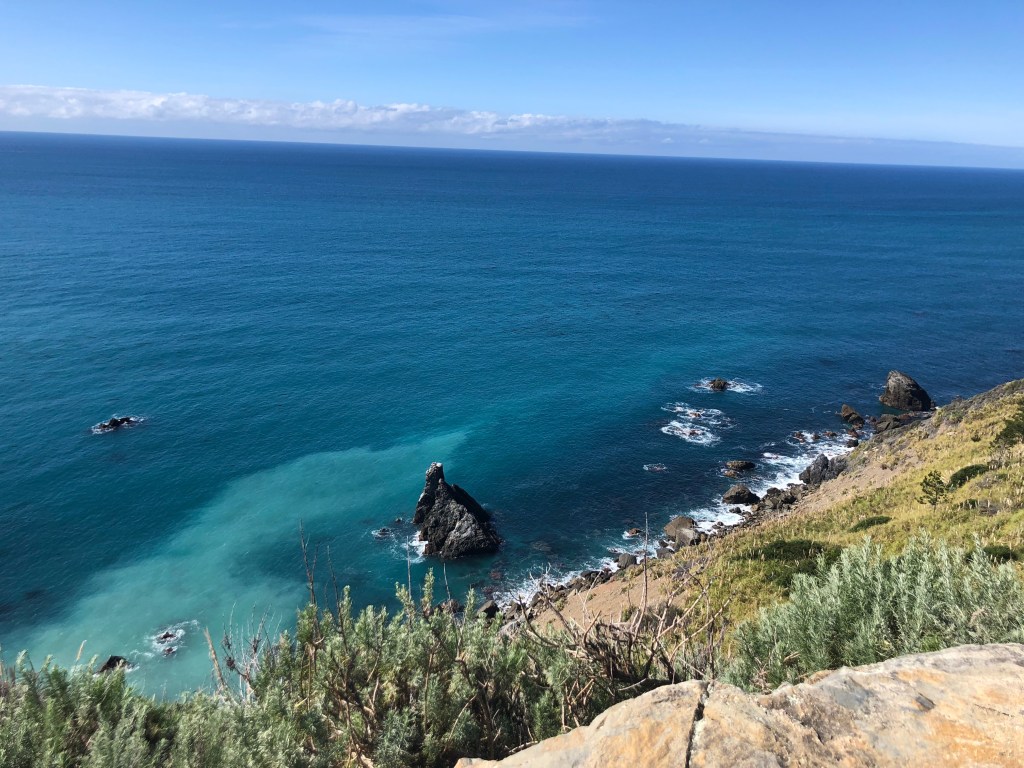
The endless blue ocean looked calm, as though a soft blanket had been stretched over the Pacific as far as the eye could see—this was my view yesterday as I drove along Highway 1 from Cambria to Carmel-by-the-Sea. The drive itself was nothing new to me; I’ve traveled this route countless times. What took my breath away, once again, was the contrast: the rugged, rocky cliffs rising beside the road, the green-folded mountains behind them, and peaks that seemed to promise views no road could ever offer. Here and there, landslides scarred the hillsides—a humble reminder of how close we travel to forces that will, in the end, always reshape the land.

Near Big Sur, Highway 1 had been closed for over two years because of a massive landslide. Just weeks before that closure, I had passed through with my husband and son, taking in the vastness of the ocean and letting the cool, salty air sink deep into my lungs—as though I were being invited to see everything around me with fresh breath and renewed senses. We stopped at Lucia Lodge Restaurant, a quiet bend along the road. Fish and chips tasted better with a glass of wine and the immense blue of the ocean as our backdrop. I remember feeling, at once, so small and strangely whole. The ocean asked for nothing more than our presence—its coastline edged with dramatic curves, rocks stacked in seemingly careless arrangements, waves splashing white against the dark stone, keeping the scene endlessly alive.

At the highest points along the road, the coastline opens into some of its most breathtaking views—vistas to take in and to carry with you long after. The curves and turns of Highway 1 create a rhythm of reveal and retreat, the ocean appearing and disappearing beside towering hills, as if offering brief invitations to look deeper before moving on.

In several stretches, large homes are nestled into the rocky edges—some barely visible, others announced by grand gates and bold stonework that only hint at what lies beyond. For a fleeting moment, I found myself wishing for a house by the sea. Each one looked like a dream. But as we continued, that longing softened into a different understanding: to own a view like this might change how one receives it. These homes are beyond what most can afford, and even those who can often come only in seasons, not to stay. The ocean, however, belongs to no one—and to everyone. It offers its quiet and its fury freely. It meets each of us where we are: those who pass by for a single afternoon, those who linger for a weekend, those who return again and again with no claim beyond gratitude.

And perhaps that is the gift. The ocean doesn’t promise permanence, only presence. It asks nothing of us except to arrive—to stand small before something vast, to feel both humbled and held. In that shared encounter, luxury and longing fall away, and what remains is a simple belonging to the earth itself. That is what draws me back—not the road, not the houses, not even the familiarity of the drive, but the quiet, enduring invitation to witness something larger than myself and to remember, again and again, that it is enough.

The Path Seeker

An excerpt from the book I’m writing, The Path Seeker:

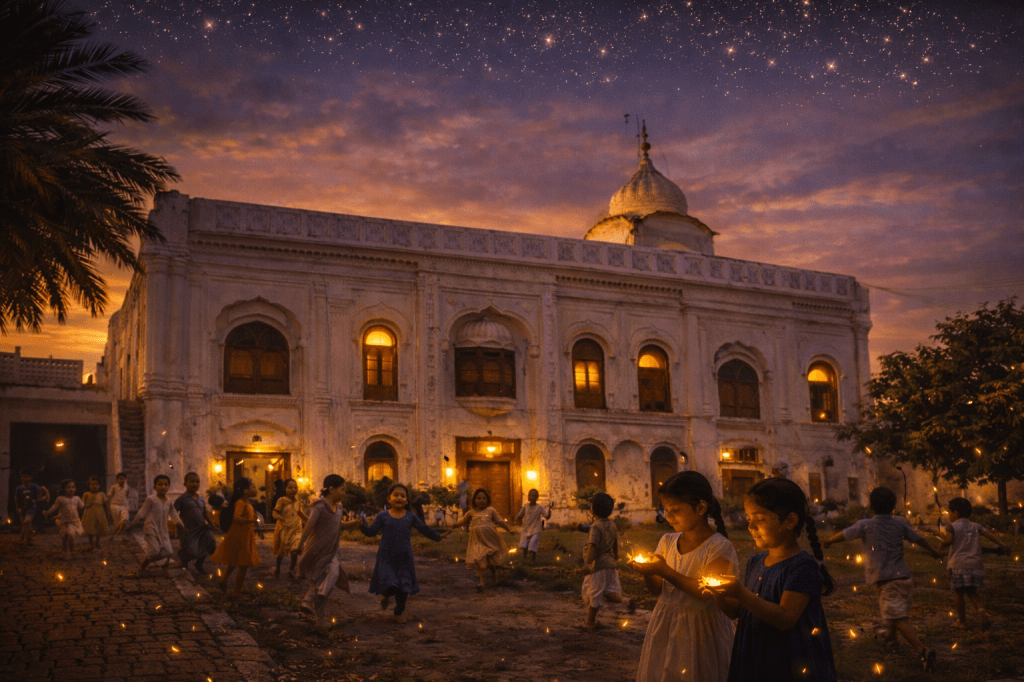
Each day, as the sun slid toward the horizon, a different kind of magic stirred. The sky unfurled in deep oranges and soft purples, and with it came the winged performers of the evening. Dragonflies zipped past like tiny helicopters, their iridescent wings catching the last light. Butterflies hovered delicately above our games. Birds wheeled overhead, circling, swooping, as though drawn into our play. And then, as dusk deepened, came the fireflies, hundreds of them, blinking in and out of the twilight like stars that had fallen from the sky.

We chased them, of course. We cupped them gently in our palms, marveling at the soft, otherworldly glow. For a moment, it felt as if we held starlight.

By nightfall, the world softened. The raucous joy of the day gave way to the quiet intimacy of sleep. I would lie there in the stillness and feel something I had never known in the city: a contentment that asked for nothing more.

The sadness I once carried—the ache of leaving behind our home in Ferozepur, my neighborhood friends, the familiar hum of the city—had melted away like sugar in warm milk. In its place came something gentler, fuller. The laughter of old and new friends. The scent of meals shared in the courtyard. The steady rhythm of village life repeated itself day after day.

Here, amid the dust and dragonflies, in a place without pavements or plumbing, I had found what I hadn’t even known I was searching for—belonging.

And each night, as Pothi Mala stood watch beneath a blanket of stars, I felt certain that something beautiful was unfolding. My old life wasn’t vanishing; it was expanding.

← Back

Thank you for your response. ✨

Rating(required)

I Like Going to Work Each Day 

I like going to work each day.

That may sound simple, even unremarkable—but it is not something everyone can relate to. For many, the workplace is a source of dread, tension, or quiet anxiety. I know this because I’ve lived it. I’ve worked in educational institutions long enough to understand the difference between a place that merely functions and one that truly nourishes the people within it. There was a time when I did not believe a workplace could be something to look forward to. And yet, after three years here, I can say with clarity and gratitude that this experience feels different—deeply and unmistakably so.

Belonging is where learning begins

As a first-generation immigrant, with English as my third language, I have often known what it feels like to be an outsider. To walk into rooms, unsure if I fully belong. To measure myself twice before speaking. To wonder whether my voice, my background, or my way of seeing the world would be understood—or quietly overlooked. Those experiences shape you. They also make you especially aware of what inclusion truly feels like when you finally encounter it.

The place I work now is where I have felt most welcomed—not just accepted, but valued. Here, I am part of something larger than myself. A shared purpose. A collective belief in what education can and should be.

Just this past weekend, we hosted our annual Open House. Families—new and returning—walked through our campus, stopping to ask thoughtful questions, pausing to observe classrooms, listening carefully, and sharing their hopes. Beneath every question was the same essential concern: Is this the right place for my child? Will my child be seen, supported, and able to grow here—not just academically, but as a whole person? Will we belong?

As I listened to parents, I realized how universal this question is. Every family is searching for more than strong academics or extracurricular offerings. They are searching for belonging, safety, and trust. And the answer I can offer—without hesitation—is yes.

What sets this school apart from others with similar hallmarks—Catholic values, academic rigor, athletics, and a focus on social-emotional development—is something harder to quantify but far more powerful. This school invests deeply and intentionally in its human capital. In the people who create the environment where learning happens. In the teachers, staff, and leaders who show up each day not just to deliver outcomes, but to live the values they teach.

Leadership here understands that while a school must be responsibly run—yes, even like a business—it cannot lose sight of its foundation. The balance between accountability and humanity is not easy to maintain. But when it is done well, it changes everything. Decisions are made with care. People are trusted. Growth is encouraged—not just in students, but in adults as well.

When I meet with parents, I often explain that they can expect to see a belief in every child’s capacity to learn and thrive. Especially those who need additional support. Especially those who may struggle quietly. Especially those who learn differently. The resources, systems, and professional expertise are in place—but just as importantly, so is the will.

This school is home to a faculty and staff whose skillsets are broad, thoughtful, and deeply grounded in intrinsic values. They work collaboratively, guided by the belief that shaping young minds is both a responsibility and a privilege. The goal is not simply academic competence, but the development of compassionate, capable, and thoughtful global citizens—children who understand both who they are and how they belong in the world.

I like going to work each day because I know the work matters. Because I feel respected. Because I am surrounded by people who care deeply about children and about one another. And because in a profession where burnout is common, this place has shown me that it is still possible to build a school culture rooted in dignity, purpose, and belonging.

That is not something to take lightly. And it is certainly not something to take for granted.

Diversity, Equity, and Inclusion Work – It’s a Marathon, Not a Sprint

The field of diversity, equity, and inclusion (DEI) has been booming for the last several years. Yet companies large and small, including educational organizations, need professional help with well-designed DEI policies, frameworks, and practices that alleviate challenges, establish an inclusive and sophisticated culture and nourish growth and opportunity for everyone. In a truly diverse, equitable, and inclusive workplace, everyone feels welcomed, accepted, and respected and has a deep sense of belonging. But that is rarely the case. In my nearly 20 years of working in education and other industries, DEI efforts have yet to move the needle on what this work should entail. This article addresses why the DEI work needs re-imagination and reconstruction and its imminent impact on social justice issues and our collective future.

Expertise as a Claimed Rule

Expertise is beneficial in any field, but it should be something other than a requirement when the field is evolving. Among the current approaches to DEI work is a preference to hire experts in the field. Having been a rookie and scholar-practitioner in DEI work long before it gained nationwide attention and momentum, newbies are just as capable as many experts. Why so? Because this work requires an abundance of human skills, creativity, and a growth mindset, primarily more than experience. Still, somehow the DEI industry and organizations value expertise as a claimed rule to be effective in DEI work and practices. A homegrown approach or hiring a relatively new DEI professional works just as well if the organization is genuinely committed to doing the work to improve the outcomes.

Accents – The Elephant in the Room

Having worked with numerous organizations on professional development training and workshops on DEI-related topics, I have observed a recurring trait. Most DEI facilitators and speakers that provide training on microaggressions, biases, race, culture, intersectionality, etc., represent the dominant (American) accent and outlook on race, culture, and diversity, and rarely do they have a foreign accent. Why are accents relevant to the DEI work? An accent is how one pronounces words and sentences. It also means that people with accents speak more than one language and are from another country or geographic region. According to the Linguistic Society of America, “everyone has an accent,” yet this variation seems to have more significant implications for those whose accents stubbornly point them to their home country, seemingly making certain accents sound more like an accent than others.

In the realm of the DEI work, suppose we predominately engage DEI professionals within the same regional contexts (e.g., western) where we’re trying to impact change rather than expose ourselves to more global contexts (e.g., oriental). In that case, the scope of impact may be limited. It does not minimize one accent over another but highlights the need to increase the diversity and inclusion of foreign accents in the DEI work. Foreign accents signify people bringing different experiences, values, cultures, and orientations that help broaden our cultural and racial contexts. To assimilate, only some immigrants engineer the dominant accent to fit in. Nor does this mean that speakers of other languages with accents are less experienced and capable in their chosen field of work, but prejudices in terms of accents have long existed in the grey zone of political correctness. As DEI professionals, we seek to enrich our work by including people from all walks of life.

The ‘Asian’ Checkmark

Part of addressing the DEI challenges in the workplace is the overreliance on how demographics are collected about America’s population by race. A typical requirement for applying for any job is collecting demographic information, and it tabulates data on the features or characteristics that define an individual or population. While the Asian population in the US is only 5.6%, it represents a large geographic area of more than 20 countries in the East, Southeast Asia, and the Indian Subcontinent, each with its unique cultures, histories, legacies, languages, and other characteristics. Of all the 50 states, Hawaii represents the highest Asian population at 39%. And about 71% of the adult Asian population were born in another country. Yet, all Asians are often lumped into a single checkmark to gather this information. No wonder many Americans fail to comprehend the uniqueness of the Asian populations, their histories, cultures, backgrounds, experiences, and perspectives, and the richness they bring to this country.

Too often, the Asian population is painted with a broad brushstroke without much consideration for their uniqueness regarding race, culture, and ethnicity. To begin the change process of increasing diversity, equity, and inclusion in the workplace, we must reimagine and reconstruct our systems on how we view, collect, and analyze information that defines a population. For example, while I may relate to some cultural and social practices and values with those in Japan, the Philippines, or Vietnam, my unique experiences and ideologies are part of my roots in India and what distinguishes me from others. Upholding our racial and cultural heritage is a huge part of our identity and existence. Being huddled or massed into a common denominator does nothing to bring value to the DEI work we aim to accomplish.

The Black and Brown Experience

An essential part of American history is learning the painful lessons of the Black people’s experience and how it has shaped the nation. Black people led the movements for equality and racial justice that has, in turn, shaped the dialogue on race, equity, and civil rights in this country. Growing up in a country that was historically under British colonial rule for almost 200 years and still has remnants of that past, I can relate to the struggles of institutionalized racism, oppression, and the fight for equality and social justice.

The non-violent movements led by M.K. Gandhi in India and Martin Luther King, Jr. in the United States say much about how race is viewed when oppression and injustice prevail. While the struggles of Black and Brown people are similar in some ways, we must be cautious not to consolidate them into one experience. The Black Americans’ past is as unique to the United States as the Indian Americans’ past in India. While oppression and discrimination anywhere may look similar in characteristics, there is no one-size-fits-all for everyone. DEI professionals would be well-served to create opportunities to surface and inform us about social justice issues faced by non-dominant groups in the workplace with distinct histories, ethnicities, cultures, and backgrounds.

DEI – Concepts That Need to be Invested, Nourished, & Protected

Diversity, equity, and inclusion are fragile concepts whose meanings and interpretations depend on how organizations view and utilize them in the workplace. If organizational leaders consider the DEI work merely as a placeholder rather than central to their future direction, they lose momentum, purpose, and value. The dominant and non-dominant groups are affected by how organizational leaders invest in DEI work. Individuals engaged in the DEI work need adequate resources, tools, power, and authority to nourish and replenish what’s required to make this work. The DEI work is beyond anything we’ve done in the past because engineering this work requires a creative and timely readjustment of systems, processes, and policies to set the right conditions for a value-based climate and environment in which growth and opportunity take shape. Therefore, who’s on top and who regulates who matters a lot. Professionals leading the DEI work in organizations, whether as internal staff or consultants/experts, are change agents and should be insulated from workplace politics and the nuances of what this work could entail.

The next time we look for a DEI professional, know that a newbie may be as good as an experienced one. The most critical attributes needed are an abundance of human skills, creativity, and a moral compass set on the right DEI values. Remember that speakers of the English language with foreign accents are an asset in this line of work. Make a conscious effort not to label individuals and populations into a simplistic form of social or demographic identity but rather understand and recognize the uniqueness they bring to our world through their distinct histories, legacies, experiences, cultures, languages, etc. Each individual brings a unique perspective to our collective understanding, and the DEI work requires us to get everyone’s identities and voices to the table. Our work aims to bring diversity, equity, and inclusion to life in the workplace, so why not reconstruct our current efforts and reimagine our future direction that bridges the gaps?

About the Author

Ruby Sodhi, Ph.D., is an education expert, DEI professional, speaker, and trainer. Ruby is the founder of Bridging It All, which helps organizations develop achievable and measurable DEI plans, frameworks, and strategies. Ruby has been part of the DEI efforts since the early 2000s. She led the DEI work when the concept was relatively new and limited resources were available to learn how to shape processes and policies to guide the DEI work. Over the past several years, Ruby has helped organizations implement DEI designs aligned with their vision, goals, and outcomes. She utilizes an asset-based and performance-based approach to guide organizations and facilitate professional development training and workshops in a welcoming, safe, and inclusive environment to boost performance and innovation in the workspace while addressing the gaps for disproportionately impacted populations.

“The Punjab Chiefs” Book’s Political Spin and Misinformation

The importance of writing ACCURATELY about history cannot be understated. As the world around fast changes to new trends and technology, so has our appetite for anything new, regardless of its source or accuracy. The glut of misinformation mounting in print and online is overwhelming, and never before has it been easier for anyone to distort facts and interpret history to suit their needs and motives. Left to interpretation, actual historical events can be at the mercy of the people with limited understanding and skill. In changing the narration about the actual events of the past, we deny others the benefit of truth and reality. Hence we erase from the memory the important historical events that led to why things are the way they are today. Once we’re removed from the truth, we are bound to follow an indoctrination or propaganda blindly.

I was recently invited to attend a book launch of The Punjab Chiefs: The Lost Glory of The Punjab Aristocracy in Punjab and Pakistan because a chapter about my Guruharsahai family’s history is included in the book. The author, Bobby Singh Bansal, had reached out to my family in early 2018 as he was “documenting their past” (Bansal, 2022). The book was sold out within minutes of its launch at the Chandigarh Golf Club event on April 6, 2022. I had to wait several weeks to buy a copy and read the information written about my family. The other day, I got my hands on a copy of this book. As I flipped to the pages about my family, to my utter bewilderment, the author had included unsubstantiated information about the Chiefs of Punjab in Guruharsahai family tree. Had this been a work of fiction, I would not have bothered to write this blog, but it isn’t, so it needs to be corrected for the record and posterity.


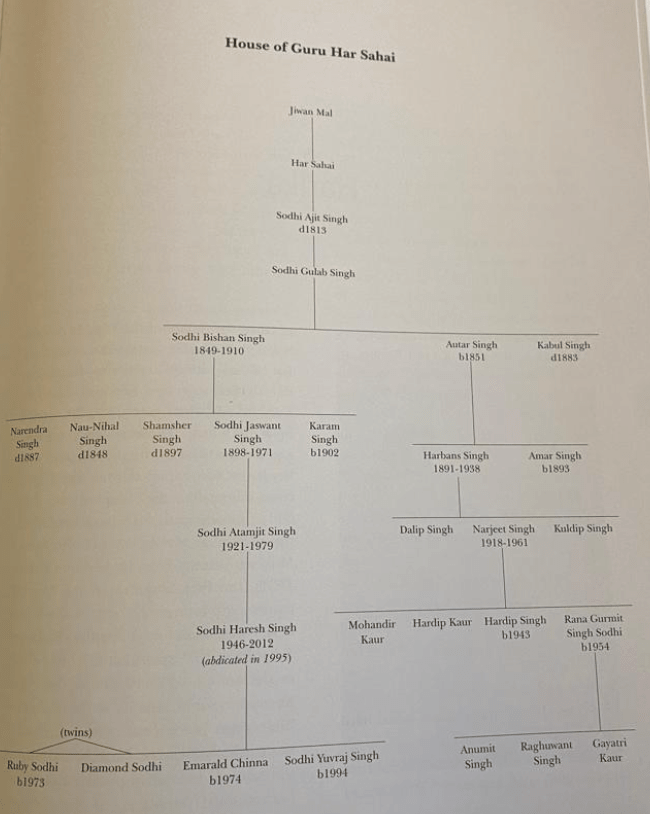
In the book The Punjab Chiefs, the chapter on the House of Guruharsahai begins the first two pages with the correct history of the Guruharsahai family, beginning with Jiwan Mal, who named my ancestral village after his eldest son Guru Har Sahai. But then the writer (Bobby Singh Bansal) somehow deviates from thereon. The writer seems to have taken it upon himself to draw an excessive family tree that gives prominence to an offshoot Sodhi family (Autar Singh) who’s related but is NOT the direct descendants of Guru Ram Das Sodhi, and whose family was never the Chiefs of Punjab from Guruharsahai. My father, Haresh Singh Sodhi, once noted that “Since the time of Jimal Mal who was 7th in descent from Guru Ram Das Ji all our ancestors have been living in Guruharsahai.” The writer ignores the closest relatives of the Guruharsahai family, who are the direct descendants of Guru Ram Das Sodhi and whose ancestors resided in Pothimala and Guruharsahai for centuries but handpicked the one name he chose to highlight in this book. To do this, Bansal (2020) arbitrarily deviated the family tree from Guru Har Sahai’s eldest grandson, known as Sodhi Gulab Singh, who had three sons (Sodhi Bishan Singh, Autar Singh, and Kabul Singh).


The eldest son was Sodhi Jaswant Singh (the 14th direct descendent of Guru Ram Das Sodhi and my great-grandfather). Bansal not only made a concerted effort to include Sodhi Gulab Singh’s second son’s name, Autar Singh, but also drew a parallel family tree outlining the lineage down to their present generation while barely mentioning the third son’s name, Kabul Singh, and ignoring the rest of their descendants.

What was the reasoning for highlighting a distant relative that is not the direct descendant of Guru Ram Das Sodhi and has little to nothing to do with the Chiefs of Punjab in Guruharsahai? Other than the fact that one of their current descendants, Rana Gurmeet Singh Sodhi, was involved in Punjab’s politics over the last two decades. The author dedicated a page and a half to glorifying the achievements of this politician at a time when Punjab, particularly Guruharsahai, had undergone the worst phase in its history. Crime, corruption, unemployment, and drug abuse have skyrocketed during the past two decades, but this book puts a different spin on the reality of Guruharsahai. Simply put, the House of Guruharsahai chapter of this book is a slap in the face of the real history of Guruharsahai as it ignores the other pertinent Sodhi families more closely related to the Chiefs of Punjab in Guruharsahai. The Punjab Chiefs book’s chapter House of Guruharsahai is disappointing for anyone interested in fair, unbiased, and accurate information about the Guruharsahai family’s historical records unless one supports the indoctrination or propaganda portrayed in this chapter.

In his speech, Bobby Singh Bansal had promised to fill in the gaps of over a century by publishing this book that highlights the lost glory of the chief families of Punjab. In fact, he has denigrated my family’s real place in history. He has overshadowed what Guruharsahai is and should be most well known for after the Sodhi family – Pothimala (www.pothimala.com), a historical site showcasing the family’s rich, descriptive murals, holy relics, and tradition of what it stands for: universal brotherhood. Thanks to authors like Bobby Singh Bansal, places like Pothimala (a 300+-year-old building that contains hundreds of splendidly painted murals bringing together the tales, folklore, rituals, sagas, and historical records from the Mahabharat, Ramayan, Mughal, and Sikh empires that blur the religious lines) would be entirely lost to time.

I wish the author had the hunger to chronicle what Pothimala stands for as much effort he put in to glorify a peripherally associated relative who is not one of the Chiefs of Punjab. Bobby Singh Bansal wrote incredible accounts of Rana Gurmeet Singh Sodhi’s political successes and achievements in shooting championships but failed to write about my grandfather, Tikka Atamjit Singh Sodhi who was the 15th direct descendent of Guru Ram Das Sodhi; who was educated at Aitchison College in Lahore; who won national championships in double trap and skeet shooting, who was given the best sailor award by V.V. Giri, and who was the chief of the Guruharsahai family.

The flood of disinformation surrounds our everyday life. The least we can do is set the record straight. In that attempt, I want to also note that the writer, Bobby Singh Bansal, plagiarized the writing I sent him in 2018, in which I had provided a written description about my family. I have no problem with him using my writing, as long as he had paraphrased it or used it within quotes. But to simply put it in his book as though it is his own writing is not acceptable.

A giant vacuum still exists, and The Punjab Chiefs book’s chapter House of Guruharsahai only adds more disinformation about my family. The Gazetteer of India, published by the Revenue Department of Punjab in 1983, noted that Sodhi Bishan Singh had “given away to his brother Autar Singh half of the property, except the abadi land, for his lifetime.” Autar Singh is Rana Gurmeet Singh Sodhi’s earliest ancestor in his family tree noted in The Punjab Chiefs book, but the writer neglects to point out this crucial historical fact that the lands were never returned to the rightful owners, the direct descendants of Guru Ram Das Sodhi.

On the other hand, our distant relative (Rana Gurmeet Singh Sodhi), whose name has now been added by Bobby Singh Bansal to the book chapter House of Guruharsahai, has allegedly received more than one compensation for the lands from the government, lands which were given to his ancestor, Autar Singh, only for his lifetime. Even though Bobby Singh Bansal acknowledged that he was “only documenting their past,” his research missed identifying these vital facts which are publicly available. It also undermines the Guruharsahai family’s suffering from a barrage of problems under an independent Indian government. The reality of what families like mine are going through is unprecedented. To deny this truth is to fool yourself and others. This blog is my effort to set my family’s record straight.

The work of writing Guruharsahai’s accurate history is unfinished but I’m confident that it will find its rightful narrator who will do justice to its history and shine a bright light on the true reality of the Guruharsahai family and the area have endured through the ages.  

A Gamut of Perspectives

Movies impact our lives in one way or another. They make us smile, cry, feel pain, and various other emotions. The Bollywood film industry has had a long passage of making movies known for their golden era showmanship to where it is now. But of late, I’ve noted that most Bollywood movies fall short of good entertainment as many are repetitive, lusterless, and often unoriginal. But some go beyond the barrier of mere entertainment and provide deep insights and value. After almost two years of a pandemic lockdown, I entered a theatre last week to watch the movie The Kashmir Files. I did not know that this movie triggered a national commotion about its content, focus, intent, and credibility. 

I’ve heard various sentiments from those who oppose or favor this movie, and their opinions are largely echoed by the media commentators and their fervent reviews about the movie. Many critics view this movie as a flawed interpretation of actual events or selective presentation, while others label it indoctrination or propaganda. But I would be remiss not to notice the narrative quality and presentation and the impeccable performance by many well-known artists helped build a stimulating plot. What stood out for me was that this movie exposed human vulnerability. Added to that is the larger vulnerability of a nation entangled in a post-independent era of inequitable growth, identity, and political concentration of power where people of minority groups are most adversely affected by the policies, actions, and apathies of the government. 

Kashmir was known as the hub of research and knowledge for scholars worldwide, an important detail underlined in the climax scene of the movie. But the harsh reality of the Kashmiri Pandits was brilliantly delivered in a single dialogue in the film, “Kaisee vidambana hai…Kashmeer ko log jannat maanate hain. aur Kashmeer ko jahannum banaane vaale bhee jihaad isalie karate hain ki unhen jannat mile.” To paraphrase and translate, it is such irony that people consider Kashmir a paradise, but the people who make hell for others in Kashmir do it in the name of jihad so they can go to heaven. 

The director used powerful and moving personal stories to showcase parallel worlds and ideologies about a place most know little about. A thought-provoking take!  

While the Western world seeks to understand better and adopt an inclusive framework of diversity and equity in all spheres of their lives, I find this discourse essentially nonexistent in India’s academic, social, and political circles. It’s almost as though equity, diversity, and inclusion are constructs independent of other variables when in fact, racial and ethnic minority cleansing is at the forefront of most social evils in this nation.

Race and ethnicity are often used as clichés for education and employment, especially for quotas and reservations that avoid any sense of the reality of a mounting divide in India’s socially, economically, politically inequitable society. For example, most people increasingly rely on low-wage workers, child laborers, and house servants to do the bulk of work that the rest of us cannot or aren’t willing to do. At the same time, we callously indulge in flippant discussions about race, ethnicity, equity, and inclusion with no real meaning or impact. 

Perhaps one of the reasons why so many people are rushing to watch The Kashmir Files is because the story shines a spotlight on some of the most pressing issues facing our society – race and ethnic consciousness. The movie brings to the forefront how ethnic violence and ethnic cleansing of innocent people are repeatedly used in the name of religion, or in other words, terrorism. 

Watching this movie brought back memories of the 1980s in Punjab that started a decade-long insurgency by Sikh militants in northern India that changed everything for me as a kid growing up in a village in Punjab. The frequent hidings, an eerie silence of anticipated ambushes and the constant fear of death, and the sound of bullets firing still haunt my memories of those times. Terrorism can be a slow-moving target of intimidation, radicalism, violence, and extremism. Still, history shows that when a nation and its people don’t stand up against hate, it can breed absolute madness carried out principally against innocent women, children, and older adults, all under the guise of religion. 

The religious persecutions, exodus, and genocide carried out against the Kashmiri Pandits, as illustrated in The Kashmir Files, is a soul-stirring reminder of how the actions and inactions of the government, educational institutions, and politicians can infringe upon the rights and values of the minority groups in a secular, sovereign, and democratic country like India.

Regardless of your stand regarding this movie, it provides the movie-goers with a critical perspective. They must decipher and define themselves and not be force-fed like a typical Bollywood movie. The movie critics are proof of that. The bottom line is people affected by terrorism in Kashmir and elsewhere have suffered a lot. The scars of terrorism forever remain for those who have faced uncertain death and devastation. Movies like this can usher a new era of entertainment in the Bollywood industry and the type of audience it attracts. Once the dust settles on what people think this movie is and isn’t, it is culturally and historically significant and has the hallmarks of a critically acclaimed international audience.