I am standing inside Pothi Mala, and the walls are still speaking.
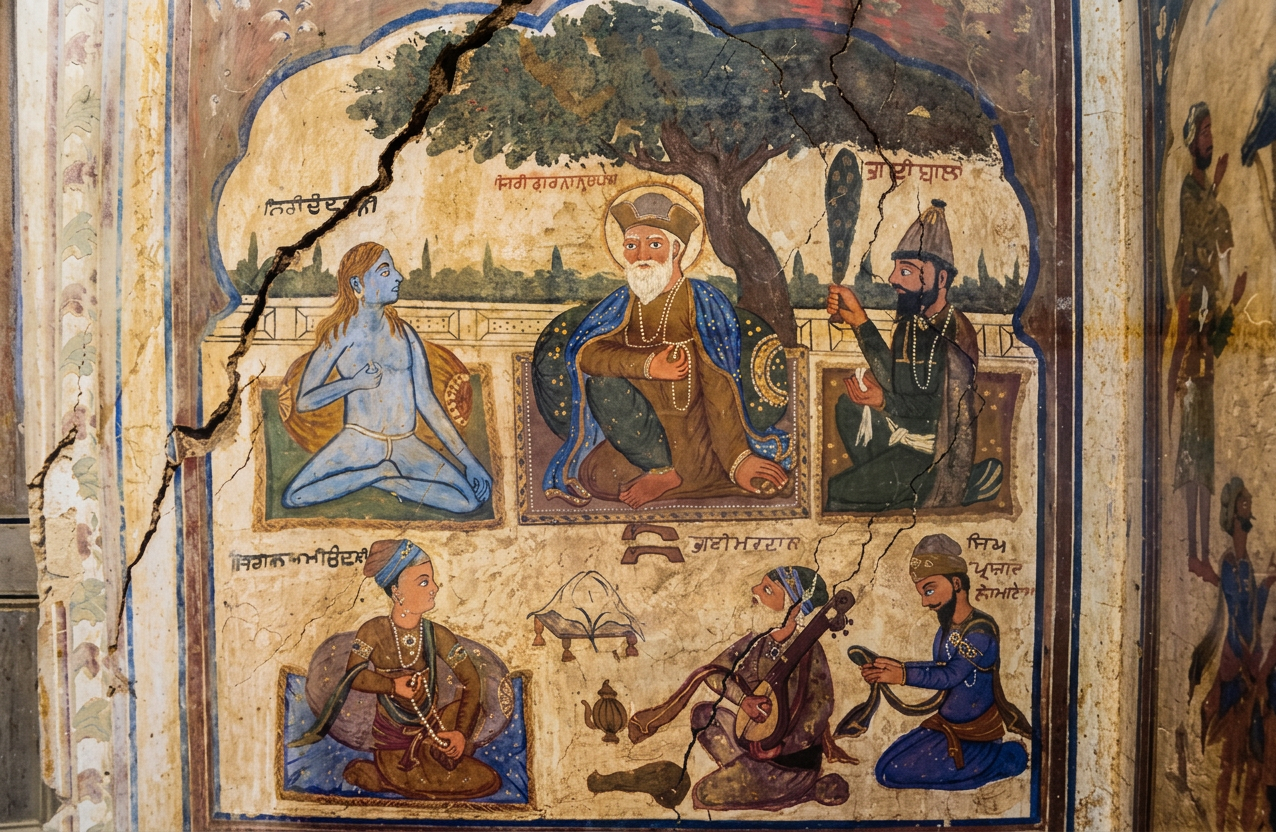
It takes a moment for my eyes to adjust — to move from the blinding Punjab afternoon into the cool, dim interior of a building that has stood since 1745. Then, slowly, they appear: hundreds of frescoes covering every surface from floor to ceiling, their colors faded but not gone, their stories intact.
A mural of Guru Nanak Dev in a quiet assembly. Scenes from the Ramayana rendered in ochre and indigo. Krishna tending cows in the forests of Vrindavan. The great Punjabi lovers — Heer and Ranjha, Sohni and Mahiwal, Sassi and Punnu — are depicted in flowing lines that have survived nearly three centuries of heat, monsoon, and neglect.
One mural stops me every time: the wedding of Lord Krishna and Rukmini, rendered in extraordinary detail. Women adorned in their finest clothes and jewelry crowd the balconies of a three-story structure. Among the wedding guests stand the Holy Trinity — Brahma, Vishnu, and Mahesh — each painted with quiet reverence, their presence a blessing upon the sacred union. Nearby, a life-sized figure of Lord Brahma surveys the room. These are not merely illustrations. Scholars who study Indian wall painting believe it is among the oldest surviving visual narratives of its kind — representations of the Satyug, the Golden Age, when divinity and humanity were understood to coexist in harmony.
Another section of walls is given entirely to Lord Krishna: his playful youth, serenading the forest with his flute while tending to cows; perched mischievously in a tree while the Gopis bathe in the river below; sitting attentively as he receives teachings from a revered sage. Scenes from the Ramayana unfold as a sequential narrative — Ram, Sita, and Lakshman exiled to the forest; the golden deer that lures them away; Ravan, disguised as a holy beggar, approaching Sita in their absence. The painters understood that a story told in images speaks to anyone who can see, whether or not they can read.
And then there are the Punjabi folk romances — Heer and Ranjha, Sohni and Mahiwal, Sassi and Punnu. These are the love stories of Punjab, its answer to Romeo and Juliet, grounded not in the courts of Verona but in the rivers, deserts, and mustard fields of this specific land. Their presence on these walls alongside scenes from Hindu epics and Sikh sacred history is itself a statement: that this building was never a shrine to one tradition alone.
Above me, the ceiling is a masterwork of painted wood panels and inlaid glass, intricate as a jewel box — every surface a continuation of the devotion that covers the walls below. Around me, the murals tell the story of a civilization that believed art was devotion, that beauty was a form of prayer.
These frescoes were painted in the ancient buon fresco tradition—pigments mixed with water and applied directly to wet lime plaster, fusing into the walls as they dried. Unlike paintings on canvas or panel that can be moved, restored, or stored, frescoes are inseparable from their architecture. You cannot save the art without saving the building. They are not decorations. They are the architecture.
And the architecture is crumbling.
Sections of the roof have collapsed. Deep fissures run along the walls, cutting through the painted faces of gods and lovers alike. In places where the ceiling has given way, rain has done what centuries of time could not — erased what was there. Each collapse takes with it something irreplaceable: a fragment of India’s sacred visual history, a brushstroke from an artisan who worked in devotion and whose name we will never know.
I grew up inside these walls.
My family has guarded this place for generations — we are Sodhis, direct descendants of Guru Ram Das, the fourth Sikh Guru and the founder of Amritsar, the spiritual capital of Sikhism — and Pothi Mala was entrusted to us as a sacred responsibility long before I was born. As a child, I understood the building the way children understand great things: as simply given, permanent, woven into the fabric of the world.
It was only later — much later, standing in California with my father’s death fresh in my chest — that I began to understand what it means for a place like this to disappear. And how easily it can happen. And how many forces are aligned to let it?
My ancestor Jivan Mal built Pothi Mala in 1745, a direct descendant of the Sodhi lineage. He named the village that grew around it Guruharsahai, in honor of the Gurus and the spiritual heritage they represented.
The building was constructed to house the Pothi Sahib, a revered collection of sacred Sikh texts handwritten by Guru Nanak Dev Ji, along with relics entrusted to the Sodhi family as guardians of the faith. For generations, it served as a living center of devotion, community, and memory—a place where disputes were brought for resolution, where families gathered, where the sacred and the everyday met. It was believed that speaking the truth in the presence of Pothi Mala brought clarity and resolution, and that those who chose deception would eventually face the consequences of their karma. Such was the power of belief that people placed in this space.
The Pothi and the Mala were eventually lost. But some relics remained: Padam Sahib, Saligram Sahib, and the Topi — belongings of Guru Nanak Dev Ji. And the building itself remained.
What makes Pothi Mala singular — what makes it, in my view, a site of genuine global significance — is not only the age of its frescoes or the quality of its craftsmanship, though both are extraordinary. It is what those frescoes collectively represent. The murals span three distinct traditions: Hindu, Sikh, and Punjabi folk. Artisans from different religious backgrounds painted them side by side, working together in an act of collaborative devotion that was never remarkable to them because it was simply how things were done. No single tradition dominates. No hierarchy organizes the walls. The Sikh Gurus share space with the Hindu Trinity. The sacred love stories of Punjab share space with the cosmic battles of the Mahabharata. It is, in the most literal sense, a monument to coexistence — built at a time when coexistence was not a political aspiration but a daily practice.
At a time when India is grappling with rising religious and communal tensions, this is not a small thing. Pothi Mala is a physical argument against division. Its existence says: this is what we were capable of. Its slow destruction says: we have forgotten.
The building predates the United States. Its frescoes predate most of the institutions now charged with protecting India’s heritage. Yet no government body has given it protected status. No conservation effort has been mounted. The Archaeological Survey of India, which oversees thousands of monuments across the country, has not intervened. The Punjab state government has not acted. Heritage protection bodies have not acted. The building continues to collapse.
My father understood what Pothi Mala was. He spent decades trying to make others understand it, too.
He was not a nostalgist. He was a practical man who had worked in public life and understood how institutions functioned — and how they failed. He submitted applications. He wrote letters. He met with officials. He sought heritage status, restoration funding, and public recognition for a building that he knew, with the certainty of someone who had grown up inside it, was irreplaceable. As he aged, his sense of urgency intensified. He could see the cracks in the walls deepening. He could see the roofline beginning to give. He understood that each monsoon season was another round of damage that no future conservation effort could fully undo.
It was not enough. The applications were ignored. The letters went unanswered. The officials smiled and offered nothing. And when my father died, the building lost its most persistent advocate — the person who had spent the longest fighting for it, who carried its history in his body, who would walk its courtyards in the early morning and simply stand there, as if by standing he could hold the walls up.
I inherited his grief and his unfinished work in equal measure. And I inherited, too, a question I have not been able to set down: what does it mean that a civilization can build something this extraordinary — this beautiful, this inclusive, this enduring — and then simply allow it to disappear?
To understand why Pothi Mala is being lost, you have to understand the political economy of rural Punjab.
Since independence, village governance in places like Guruharsahai has been shaped less by policy than by personality — by patronage networks and the slow entrenchment of corruption at every level. Agrarian reforms of the mid-twentieth century gave way to identity politics. Religious institutions that might have protected cultural heritage became instruments for consolidating political power.
The militancy of the 1980s brought development in rural Punjab to a near-complete standstill. Entire communities were traumatized. Infrastructure projects were abandoned. The institutions meant to serve villages like Guruharsahai became either dysfunctional or complicit. While cities began to recover through the 1990s, rural Punjab was left behind — its cultural landmarks unprotected, its young people without economic prospects, its memory slowly bleeding away. The liberalization era that followed concentrated wealth in the hands of the politically connected, deepening the divide between those who could leave and those who could not.
Every election cycle follows the same script — the next arriving in February 2027. Politicians appear with promises. Cash and alcohol circulate quietly in exchange for votes. The election ends. The politicians disappear. In the years I have been watching, not one has taken meaningful action to restore or protect Pothi Mala. Applications submitted to government bodies seeking heritage status or restoration funding have been ignored or denied. Local school curricula make no mention of the historic building that stands at the center of the village. An entire generation of young people in Guruharsahai is growing up without knowing what their village holds.
Meanwhile, the drug crisis that has ravaged rural Punjab for decades has reached Guruharsahai with particular force. A generation of young men is being lost to addiction, sustained by networks of politicians, traffickers, and middlemen who operate with impunity. The community’s protectors are too often in league with its destroyers. Hope has become a rare commodity. And into this vacuum of despair, Pothi Mala stands — not as an answer, but as a reminder of what was once possible here.
There is also the quieter damage — the kind done not by neglect but by deliberate distortion. In the age of digital media, the history of a place like Pothi Mala is vulnerable to manipulation. False genealogies circulate online. Public platforms are edited to replace documented history with fabricated narratives. Pseudo-histories appear, written by those who seek to claim an inheritance they were never given. The erasure of memory, it turns out, does not always come from indifference. Sometimes it is engineered.
A larger question lies beneath all of this — one that extends well beyond a single building in a single village in Punjab.
Who is responsible for the preservation of sacred cultural heritage when the institutions meant to protect it fail? This question is not unique to India. Across the world, heritage sites are disappearing—through neglect, conflict, the deliberate erasure of histories that powerful groups find inconvenient, and the simple indifference of governments with other priorities. The international community has developed frameworks to respond: UNESCO’s World Heritage program, the Hague Convention for the Protection of Cultural Property in the Event of Armed Conflict, and the work of organizations such as the World Monuments Fund and the Aga Khan Trust for Culture. These frameworks exist because the world has recognized, at least in principle, that certain things belong to everyone — that the loss of Palmyra, the Bamiyan Buddhas, or the manuscripts of Timbuktu is not merely a local tragedy but a wound to the shared human record.
Pothi Mala has not been nominated for any international protection. It does not appear on UNESCO’s tentative list. The Archaeological Survey of India does not recognize it as a protected monument. For official heritage frameworks, it exists as if it does not exist at all—a building of extraordinary historical, artistic, and spiritual significance that has somehow fallen through every net meant to catch things worth saving.
Part of the reason is institutional: the systems for identifying and protecting heritage sites in India are overstretched, underfunded, and vulnerable to the same political pressures that have failed Guruharsahai at every level. Part of the reason is geographic: rural Punjab is not on the itinerary of scholars and heritage professionals who might otherwise recognize Pothi Mala. And part of the reason is epistemological — a question of whose knowledge counts, whose testimony is taken seriously, who gets to declare something significant. The descendants of those who built and maintained Pothi Mala have been saying for decades that it matters. That testimony has not been enough.
What would it take for the world to see Pothi Mala? Not through the eyes of a descendant — through the eyes of an institution with the power to act? I think of the conservation programs at universities like the Courtauld Institute in London, the Getty Conservation Institute in Los Angeles, and the National Museum Institute in New Delhi. I think of the international heritage organizations that have intervened to save buildings no less obscure than this one in other parts of the world. I think of the individual collectors, foundations, and cultural philanthropists who understand that the preservation of art is not sentiment — it is the maintenance of the human record.
I often think about the artisans who painted these walls.
We do not know their names. We do not know which tradition each came from, though the evidence of the murals themselves — the fluency with which Hindu iconography sits alongside Sikh sacred history and Punjabi folk romance — suggests they came from different faiths and worked together without apparent tension. They mixed their pigments with water and applied them to wet plaster, knowing that what they were doing would last. They painted gods, lovers, sages, and warriors. They painted the cosmic and the human side by side. They painted beauty as an act of devotion — not to any single tradition, but to something larger than tradition.
What they created is, in the most precise sense, a document. Not a political document or a theological document, though it is both of those things, too. It is a document of what human beings can do when they work across differences toward something shared. In an era of rising division — religious, communal, political — that document has never been more urgently needed. And it has never been closer to disappearing.
Preservation, in this sense, is not conservation. It is not merely the technical work of stabilizing plaster and restoring pigment, though that work is necessary and urgent. It is an act of moral attention — a declaration that this matters, that the people who built it mattered, that the civilization that produced it deserves to be remembered. To preserve Pothi Mala is to insist that coexistence has a history. That it was not always an aspiration — that once, not so long ago, it was simply how things were done.
My father spent the last decades of his life trying to make that argument to people who were not listening. I am making it now, in a different medium, to a different audience, hoping that somewhere in the distance between his generation and mine, something will shift.
I am standing inside Pothi Mala, and the walls are still speaking.
The question is whether anyone is still listening.
 Ruby's Musings