Whizz. Zip. Hum.
The hummingbird began its morning ritual early, its tiny wings moving so fast it seemed suspended in the air — hovering from flower to flower, gathering nectar pooled deep within their petals. Nearby, a squirrel traced its restless path across the rooftop, its chatter so familiar it had long since crossed into affectionate annoyance.
Still, the day unfolded in a quiet glow, rising with warmth and sunlight.
Sitting on my deck, I breathe in the earthy freshness of the mountain air, feeling my lungs open with each breath.
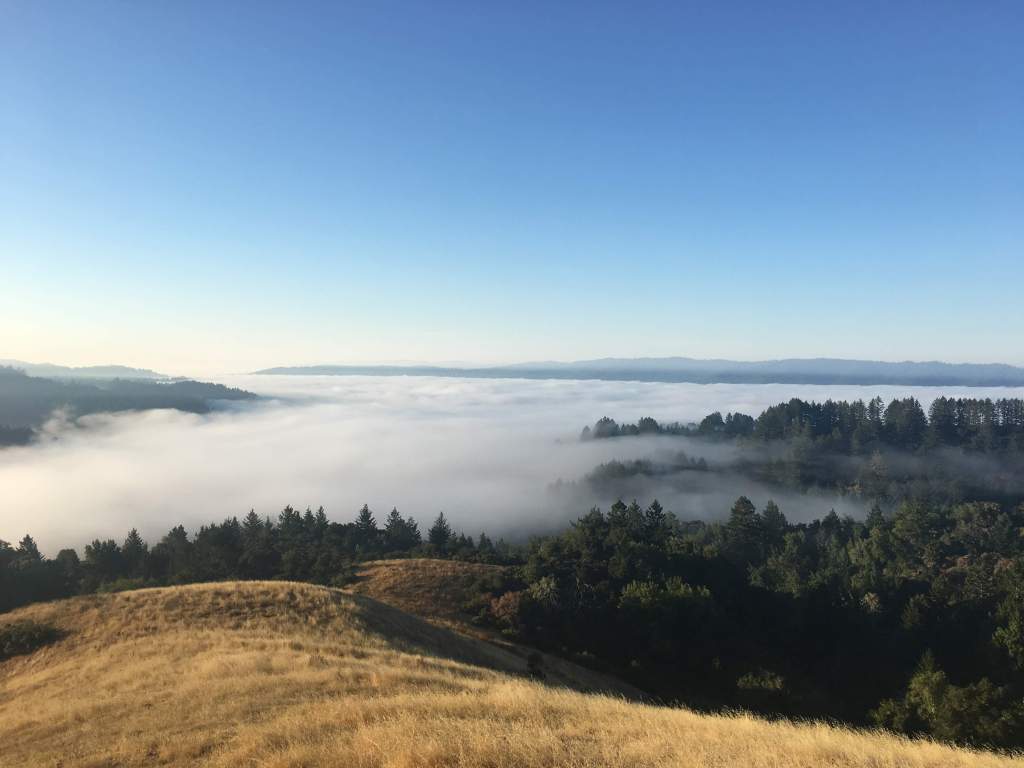
Sunrise and sunset, the slow unfurling of fog across the hills — all of it echoes a stillness that asks for nothing more than presence. The reddish-maroon hues of the redwoods reveal themselves not in full daylight, but as the sun dips toward the horizon, especially after rain, casting a warm glow across their ancient trunks.
Such is life in the Santa Cruz Mountains. For over fifteen years, I have lived within this almost ethereal landscape, and its everyday gifts have never lost their quiet magic.
The call of the hills has been nothing short of a dream come true for me.
I was ten when I was sent to boarding school, nestled in the foothills of the Himalayas in India, at an altitude of about 7,500 feet, in the hilltop city of Shimla—once the summer capital of the British Raj. I was homesick for months. I spent my free time at the edges of the school’s seven playgrounds, overlooking an expansive valley layered with endless mountain ridges.
There were days when my eyes searched that landscape for something familiar, something that felt like home. Scattered across the terrain were rooftops in shades of red, green, white, and slate. From some, thin trails of smoke rose into the air, carrying the distant scent of wood fires and cooking. It felt warm and comforting.
I longed for a home like that—a quiet place nestled in the mountains, its rooftop barely visible among the trees. Three decades later, that is exactly where life brought me — and the mountains have been teaching me ever since.
Here in the Santa Cruz Mountains, each season brings its own character. On intensely hot days, the Redwoods release soft spatters of seeds into the air. On windy days, their mighty trunks sway as if in a slow waltz. Other days, fog rolls in to cradle the trees and the valley in a blanket of soft white cloud.
To pass through on a winding road is to glimpse only the surface of this place. While visitors gather at its familiar parks and attractions, those who live here discover a quieter world—hidden trails and shifting landscapes that reveal themselves slowly, and only over time.
There is also a rich community of mountain dwellers who have chosen to make their lives within the folds of these peaks, valleys, and crevices. From the valley below, mountain dwellers are often misread — dismissed as hippies, isolationists, or simply eccentric. But those who live here have chosen something far more deliberate: a life balanced between connection and solitude, close enough to neighbors, yet deeply held within the embrace of nature.
That balance shapes daily life in quiet, thoughtful ways—from the size and structure of a home to its light, water, and relationship to the land. Living here is not accidental; it is an ongoing act of design, a careful tending of both space and self.
In the city, one has neighbors; in the mountains, we have community—people who genuinely care, who show up without being asked, and sometimes without even announcing themselves. That kind of quiet camaraderie feels increasingly rare in cities, where neighbors often know little about those living just next door.
And then there are the other neighbors. The quiet, constant presence of wildlife—the deer, bobcats, wild turkeys, skunks, foxes, coyotes, partridges, and, on occasion, a mountain lion. Here, adults and children alike don’t just read about these creatures; we live alongside them. There are moments—unexpected, almost surreal—when our human lives brush gently against theirs, and for a brief instant, we share the same space, aware of one another in a way that feels both humbling and extraordinary.
From the mountains of Shimla to Santa Cruz, their quiet call has traced an arc through my life. Perhaps that is their promise—that they do not draw us away from life, but deeper into it. Into stillness, into presence, into a way of being that cannot be hurried. The longing I carried as a child, looking out across distant mountains, was never just for a home, but for a feeling. And somehow, over time, that call was answered—softly, patiently—until I found myself living inside the very dream I once watched from afar.